Featured research · 2022
IEEE Access
Controller Design and Disturbance Rejection of Multi-Quadcopters for Cable Suspended Payload Transportation Using Virtual Structure
A virtual-structure leader–follower controller enables multiple quadcopters to transport a cable-suspended payload, reconfigure their formation in flight, and reject cable, wind, and modeling disturbances.
Cooperative transport as one structure
This work treats multiple quadcopters and their cable-suspended payload as a coordinated transport system whose formation can change while the vehicles remain in flight.
The virtual-structure formulation provides a common geometric reference for the leader and follower vehicles. By changing the relative formation vectors, the group can reshape itself during a mission while continuing to carry the shared payload.
Cable-suspended system
The transportation platform uses multiple quadcopters connected to a payload through cables. Instead of requiring a complete coupled payload model, cable tension, payload gravity, wind, and unmodeled effects are collected as disturbances acting on the individual vehicles.
Control and disturbance rejection
Position and force control are combined with force and torque disturbance observers. The observers estimate the aggregated disturbances online so that their effects can be compensated while the virtual-structure leader–follower controller maintains the commanded trajectory and formation geometry.
Flight experiments
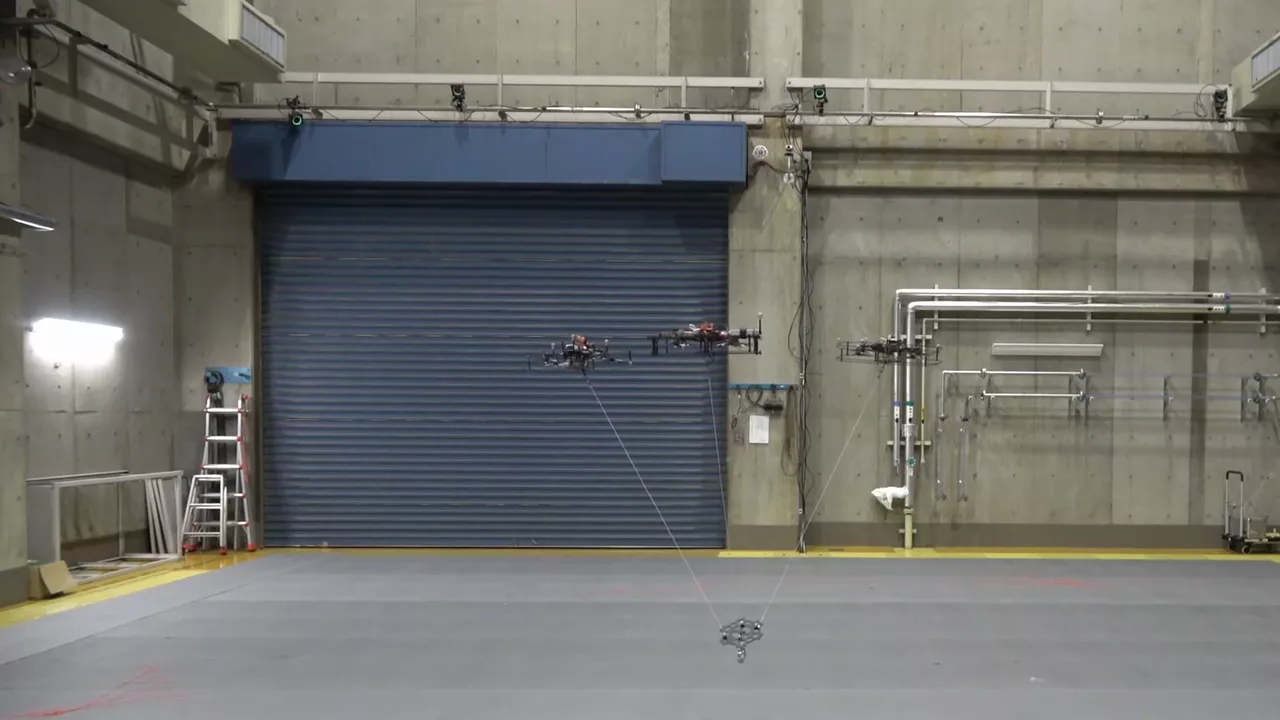
Indoor experiments demonstrate cooperative payload transportation with three quadcopters, including translational motion, in-flight formation reconfiguration, and operation under external disturbance. The video above presents the formation change sequence used for this featured research view.
Publication
The paper was published in IEEE Access, volume 10, pages 122197–122210, in 2022. The complete article is available through IEEE Xplore.