Numerical Simulation of a Novel Cargo Handling Strategy: Using a Centralized Cable-Linked Dual-Multirotor System

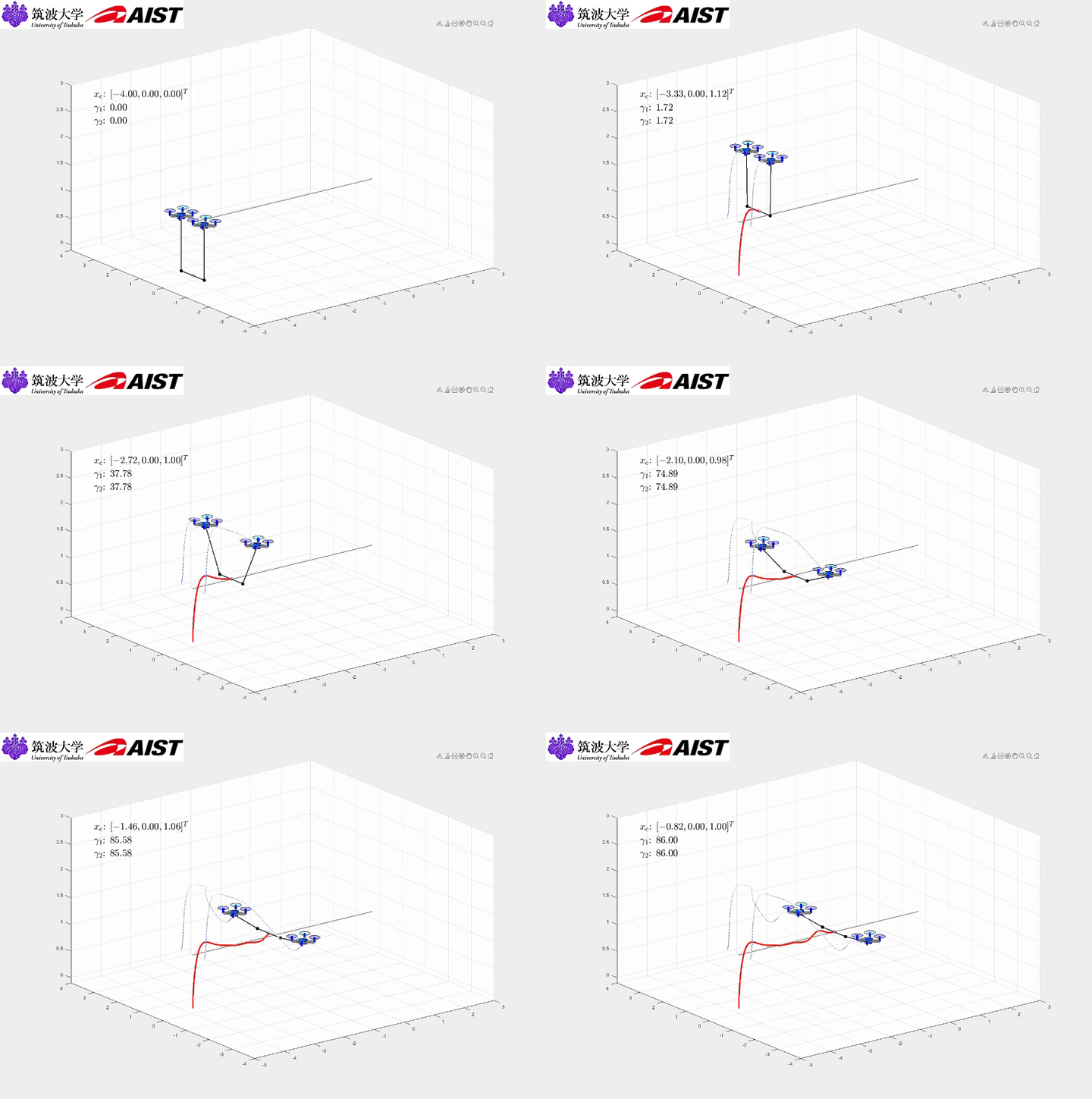
This paper investigates a novel cargo handling strategy for aerial transportation using a centralized cable-linked dual-multirotor system. The work focuses on enabling autonomous loading, transportation, and unloading of cargo without relying on onboard mechanical manipulators, which are often inefficient and complex for medium- and long-distance UAV logistics.
To achieve this goal, the authors propose a Tug-of-War (ToW) method, in which two multirotors pull against each other through a shared cable to establish internal tension and maintain cable rigidity during loading and unloading. By equipping the cargo with two passive hooks, the system can autonomously dock, lift, and transport payloads of arbitrary shape and weight while preserving a safe distance between the multirotors and mitigating cable sagging effects.
From a modeling perspective, the system is formulated using a rigid cable-linked representation on nonlinear configuration manifolds, where the horizontal cable segment is treated as the centralized controlled object, and the hooks, suspension segments, and attached cargo are modeled as disturbances. Building on this formulation, a hybrid control strategy is developed by integrating geometric control with a model reference adaptive nonlinear model predictive control (MRA-NMPC). This combination enables adaptive regulation of cable geometry (gamma angles) and robust control performance under unknown payload parameters and model mismatches.
Numerical simulations of both loading and transportation processes demonstrate the feasibility of the proposed ToW method and validate the adaptability and robustness of the hybrid controller in the presence of disturbances and uncertainty. The results indicate that the proposed strategy effectively bridges the gap between centralized and decentralized cable-suspended transportation methods, providing a flexible and scalable solution for autonomous aerial cargo handling.
