Robustness Enhancement for Multi-Quadrotor Centralized Transportation System via Online Tuning and Learning

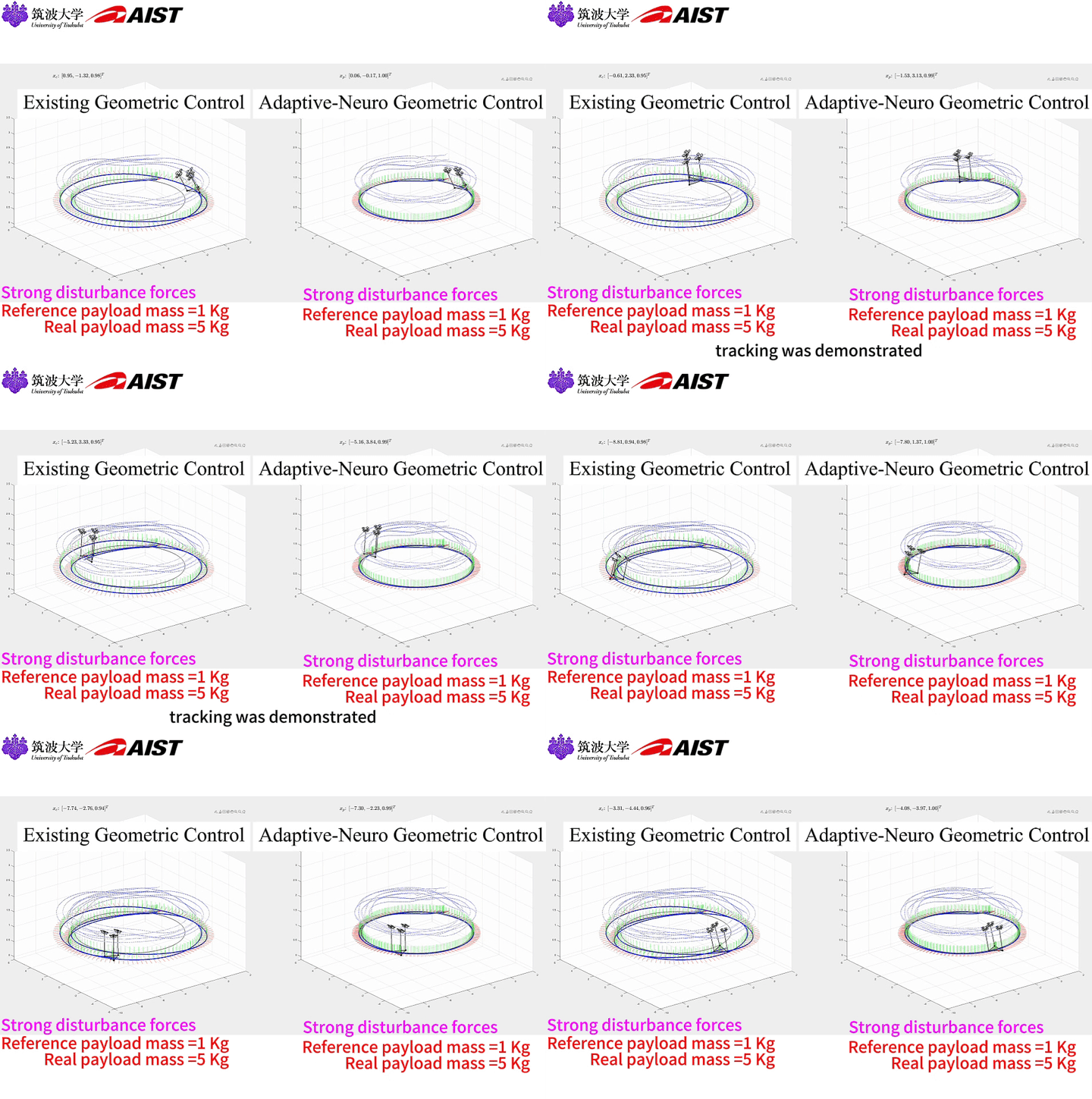
This work presents an adaptive–neuro geometric control framework for a centralized multi-quadrotor cooperative transportation system carrying a cable-suspended payload. The main objective is to enhance system robustness against both parametric uncertainties (e.g., unknown payload mass and inertia) and external disturbances (e.g., wind forces and moments), which are common challenges in real-world aerial transportation tasks.
Building upon an existing centralized geometric control architecture, the proposed approach augments the first-level payload control signals with online tuning and learning mechanisms. Specifically, multiple radial basis function (RBF) neural networks are employed to approximate unknown disturbance dynamics in both translational and rotational subsystems, while adaptive laws are simultaneously introduced to estimate uncertain payload parameters. These two mechanisms interact cooperatively: adaptive parameter tuning globally scales the controller behavior, while neural networks locally compensate for time-varying disturbances.
A key feature of the proposed method is that no pre-training or persistent excitation (PE) condition is required. All neural network weights and model parameters are updated online using Lyapunov-based adaptation laws, ensuring bounded estimation errors. The authors provide a rigorous Lyapunov stability analysis, showing that the closed-loop system achieves semi-global practical stability under bounded disturbances and modeling uncertainties. When reference model parameters are matched and static attitude tracking is considered, stronger stability guarantees can be obtained.
The effectiveness of the proposed control strategy is validated through numerical simulations of a three-quadrotor transportation system. Comparative studies demonstrate that, relative to conventional geometric control, the proposed adaptive–neuro approach significantly improves robustness in scenarios involving large payload mass mismatch, inertia uncertainty, and strong external disturbance forces or moments.
Overall, this work contributes a lightweight, theoretically grounded, and practically implementable solution for robust centralized aerial transportation, with clear potential for extension to real-world experimental validation and more comprehensive stability analysis in future work.
