Online Identification using Adaptive Laws and Neural Networks for Multi-Quadrotor Centralized Transportation System

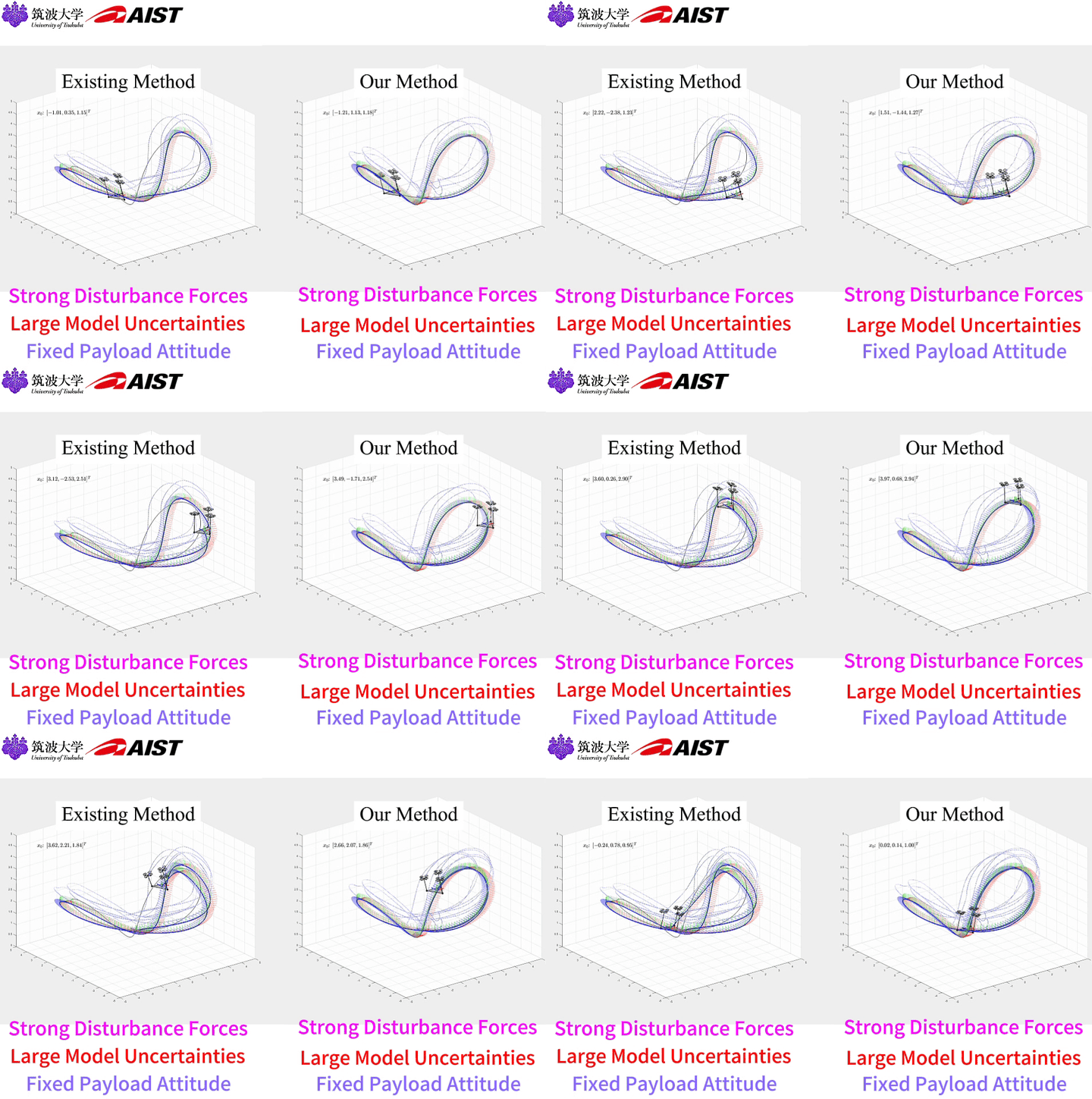
This paper presents an online adaptive–neuro identification framework to enhance the robustness of centralized multi-quadrotor cable-suspended payload transportation systems. The proposed method addresses the challenges arising from highly coupled nonlinear dynamics, unknown payload parameters, and time-varying disturbances by introducing a dimension-decomposed learning strategy.
The core idea is to decompose the high-dimensional payload error space into multiple low-dimensional subspaces, referred to as “slices.” Within each slice, shallow neural networks and adaptive laws operate in parallel to identify model uncertainties and disturbance dynamics online. This structure, termed Sliced Adaptive-Neuro Mapping (SANM), enables efficient real-time learning without requiring persistent excitation or offline training, while preserving theoretical transparency.
The SANM module is integrated as a feedforward compensator into a payload-centric geometric control architecture. By learning directly from Lie-algebra–based error representations, the proposed framework avoids explicit modeling of complex cable–quadrotor couplings and improves disturbance rejection for both translational and rotational payload dynamics. Stability of the overall closed-loop system is rigorously analyzed using Lyapunov theory, and uniform ultimate boundedness of tracking and estimation errors is established under unknown payload parameters and time-varying disturbances.
Numerical simulations demonstrate that the proposed method significantly enhances tracking performance and robustness compared with conventional centralized control approaches. The results indicate that dimension-decomposed adaptive–neuro learning provides an effective, lightweight, and theoretically grounded solution for robust aerial cooperative transportation.
